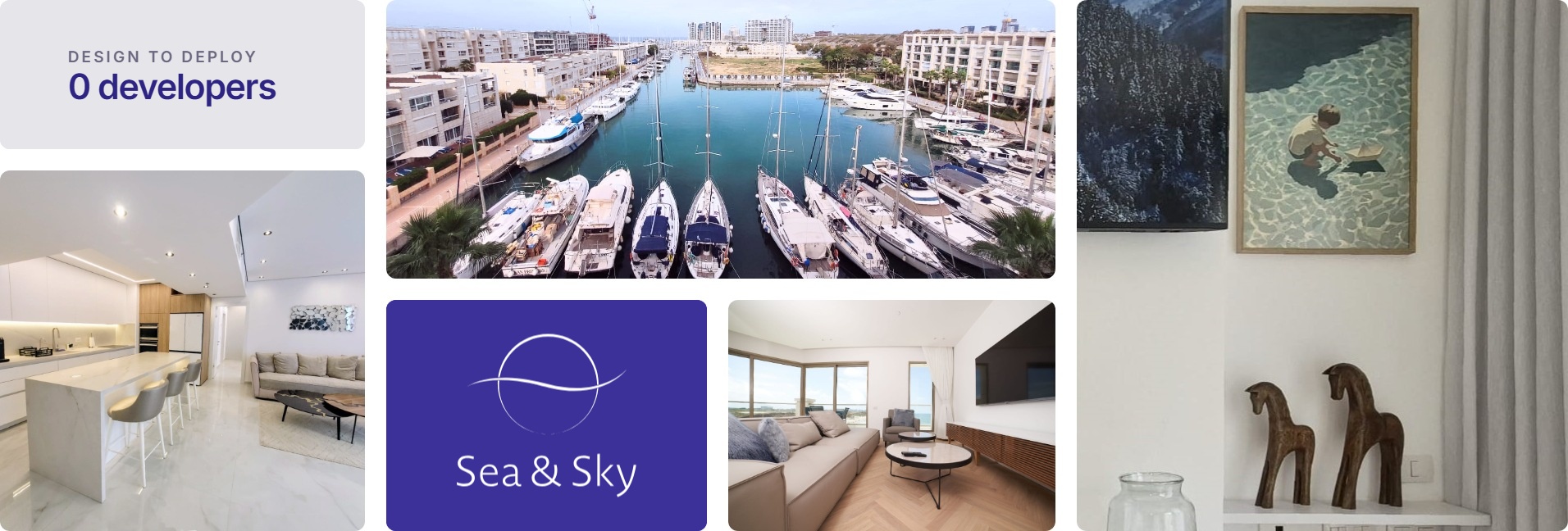
A production website for a luxury real-estate agent in Herzliya Marina – two languages, custom domain, live email, search-indexable in both. Designed, built and shipped by one person in two days, with no developer and no agency involved.
Visit the live site ↗
Matan Carmeli sells luxury property around Herzliya Marina and had no digital presence of his own – his listings lived entirely on other people’s platforms. Nobody commissioned this site. I saw that he needed a home that actually belonged to him, and I built it.
This is the part that makes “two days” mean something. Every item below was live and verified at the end of it.
The logo is earlier work for the same client, reused here as the site’s natural foundation. Everything downstream of it – the palette, the typography, and the layout hierarchy – was defined specifically for this build.
Designed for Matan and for what he actually sells: hospitality made whole.
The idea was built around a simple promise: a home away from home. In luxury real estate, it is easy to make something cold, expensive, and aloof. But Matan doesn’t just broker properties; he hosts people. The goal was quiet luxury where a guest walks in and feels instantly at ease – genuine comfort over posture.
The mark is two shapes. The disc is that wholeness, and it is also the Mediterranean sun rising over the Marina. The line through it is a calm wave on the horizon – stillness, balance, and the sea this whole lifestyle is built on.
Prestige on the outside, but drawn to feel like an open door.
One navy, one lift of it, and a greyscale that does the rest. A property site should not compete with the photography – the pictures carry the colour, so the interface holds still.
Heebo, and only Heebo – one family carrying both scripts. A bilingual site that pairs two typefaces has to keep them in step at every weight and size forever; one family that draws Hebrew and Latin as siblings removes that problem instead of managing it.
מתן כרמלי – נדל”ן יוקרה במרינה הרצליה
Matan Carmeli – luxury property, Herzliya Marina
The site was built with generative AI assistance. These are the points where the default output was wrong, and the work was knowing why.
The tool defaulted to client-side browser detection – the standard automated shortcut. But Matan’s local buyers search in Hebrew, while Googlebot crawls with a US-English locale.
Gave each language its own dedicated URL path and made the URL the only source of truth. Under browser detection, the Hebrew site would never have been indexed at all. The language switch is a crawlable <a href>, not a JavaScript button, so search engines can actually follow it.
The generated export relied on React with an in-browser compiler – convenient for a quick demo, but completely unfit for production.
Rebuilt the entire codebase in clean, semantic HTML, CSS, and vanilla JavaScript. A brochure site for a boutique real-estate agent doesn’t need a runtime framework; it needs fast load times, no build steps, and zero technical debt.
A generic WhatsApp icon sat in the social row alongside Facebook and Instagram, dumping visitors into a blank personal chat with no context.
Removed it. An empty chat window asks the visitor to do all the work. Instead, the contact flow routes through a dedicated WhatsApp deep-link carrying pre-filled, localized copy that visitors can review and send with one tap. Zero backend overhead, zero stored data.
The standard real-estate contact form: a name and a number, operating on the lazy assumption that the agent can simply call whenever they are free.
Designed a preferred callback window into the inquiry flow from the very first mockup. I know Matan’s clientele – their time is their most valuable asset, and an unexpected sales call in the middle of a meeting is jarring friction. Giving them control over when the conversation happens isn’t just a convenient form field; it’s an act of hospitality that respects their schedule before saying a word. The selected time is packaged directly into the prefilled WhatsApp message, setting an attentive, high-touch tone from the very first interaction.
The AI built the scaffolding fast; I sculpted the result.
The tool doesn’t have an eye. It doesn’t understand quiet luxury, editorial restraint, or why a specific margin makes a photograph feel expensive. I came in with a clear visual target and steered the tools step-by-step, refining the typography, tightening the layout, and overriding automated choices until the site landed on the exact look and feel I wanted.
Speed came from the software. The precision, the visual discipline, and the soul of the interface came from twenty years of designing things properly.
AI compressed the production, not the judgment.
Two days was possible because twenty years of practice decided what to ask for, how to shape it, and what to throw away.
The same tools, in hands without that foundation, produce a site that looks finished on the surface – and cannot even be indexed.
Built with Claude Design and Claude Code.
Visit the live site ↗